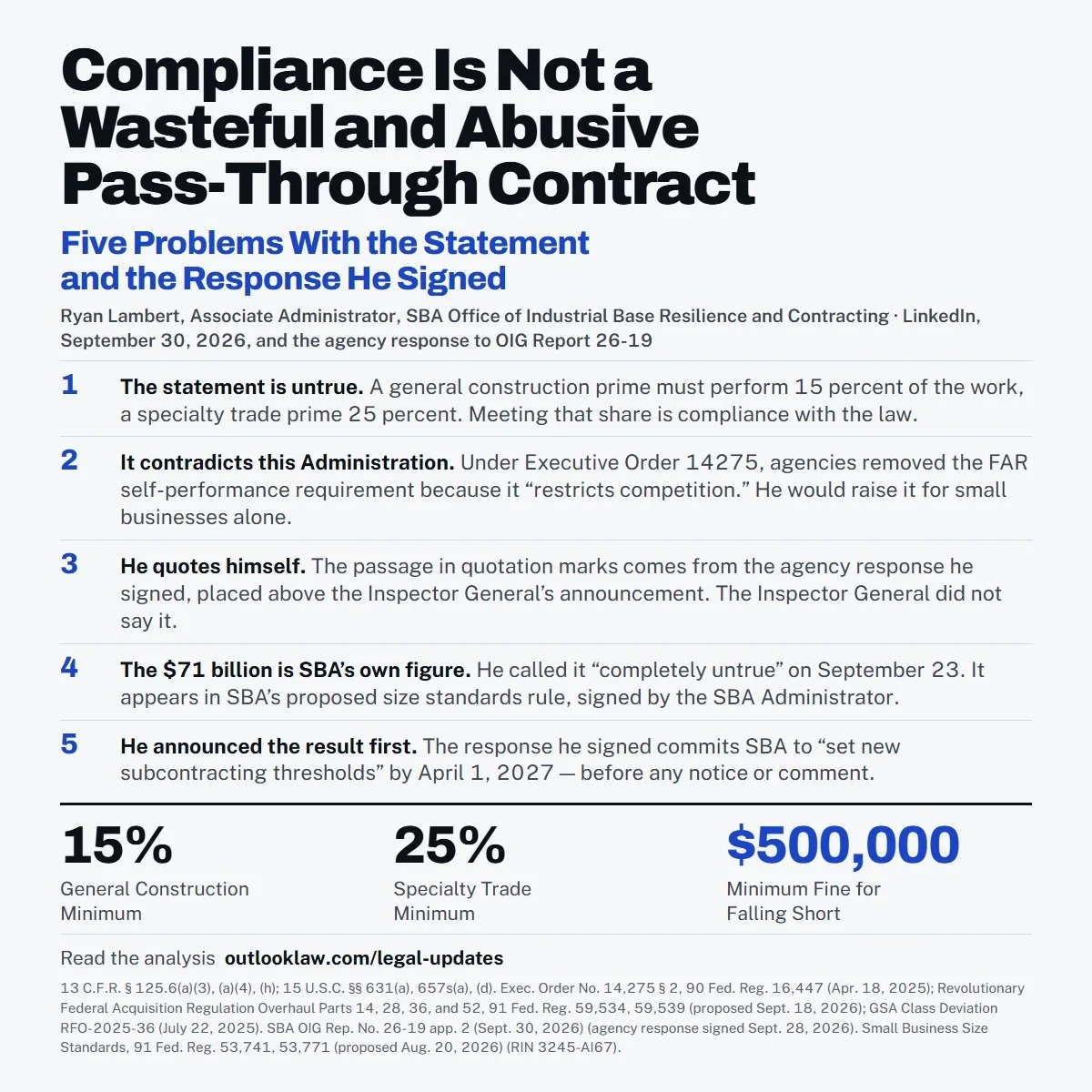
On September 30, 2026, SBA’s Associate Administrator for the Office of Industrial Base Resilience and Contracting posted a statement on LinkedIn about small business construction contracts. The same day, SBA’s Office of Inspector General released Report 26-19. The statement, and the agency response he signed to that report, conflict with Executive Order 14275, the FAR Council, and GSA.
One — The statement is untrue.
He calls small business construction contracts that comply with the law “wasteful and abusive pass-through contracts.” On a general construction set-aside, the prime contractor together with similarly situated small businesses must perform at least 15 percent of the work, excluding materials. For special trade contractors the share is 25 percent. 13 C.F.R. 125.6(a)(3), (a)(4). A contractor that meets that share is complying with the law. Compliance is not a pass-through.
A prime that collects a fee and performs no work already violates the rule today. The penalty is the greater of $500,000 or the amount it overspent on subcontractors. 13 C.F.R. 125.6(h).
Two — He contradicts the Policy Position of this Administration.
Under Executive Order 14275, agencies removed the FAR Part 36 self-performance requirement for construction prime contractors by class deviation. The FAR Council has proposed to remove it permanently. Its stated reason: the clause “restricts competition because not all contractors self-perform work,” and removing it “should result in lower prices.” 91 Fed. Reg. 59534, 59539. He would raise the requirement for small businesses alone, and restrict competition.
Three — He quotes himself.
The passage he posted in quotation marks comes from the agency response he signed, printed at Appendix 2 of Report 26-19. He placed his own words in quotation marks above the Inspector General’s announcement of the report. The Inspector General did not write them.
The Inspector General did identify pass-through risk. It traced that risk to monitoring and enforcement, not to the percentages. Its first recommendation is to revise 13 C.F.R. 125.6 with “unambiguous, mandatory language” to ensure consistent interpretation, application, and enforceability. It directed that recommendation to the Associate Administrator for the Office of Industrial Base Resilience and Contracting. The Inspector General did not recommend new percentages.
Four — His September 23, 2026, statement was also untrue.
He called a claim about $71 billion in contracts “completely untrue.” That figure appears in SBA’s proposed size standards rule, signed by the SBA Administrator, which names him as its contact. 91 Fed. Reg. 53741, 53771, 53784.
Five — He announced the result before the rulemaking.
The response he signed commits SBA to draft revisions to 13 C.F.R. 125.6 by April 1, 2027 that “[s]et new subcontracting thresholds.” Any change to the construction percentages requires public rulemaking with notice and comment. 15 U.S.C. 657s(d)(1), (3).
Statements that are untrue are reckless, dangerous, and harmful. Being compliant is not unlawful, wasteful, or abusive. The pattern of statements is clear, and it goes against this Administration as well as the mission of the Small Business Administration to “aid, counsel, assist, and protect” small business, the backbone of our Nation’s economy. 15 U.S.C. 631(a).
Sources: Ryan Lambert, LinkedIn (Sept. 30, 2026) (as posted; since edited); SBA Office of Inspector General, Consolidated OIG Findings on Subcontracting Limitation Concerns for Set-Aside Awards, Report 26-19, app. 2 (Sept. 30, 2026) (agency response signed by Ryan A. Lambert); 13 C.F.R. 125.6(a)(3), (a)(4), (h); 15 U.S.C. 631(a), 657s(d)(1), (3); Exec. Order No. 14,275, 90 Fed. Reg. 16447 (Apr. 18, 2025); Revolutionary Federal Acquisition Regulation Overhaul Parts 14, 28, 36, and 52, 91 Fed. Reg. 59534 (proposed Sept. 18, 2026); GSA Class Deviation RFO-2025-36 (July 22, 2025); Small Business Size Standards, 91 Fed. Reg. 53741 (proposed Aug. 20, 2026).